

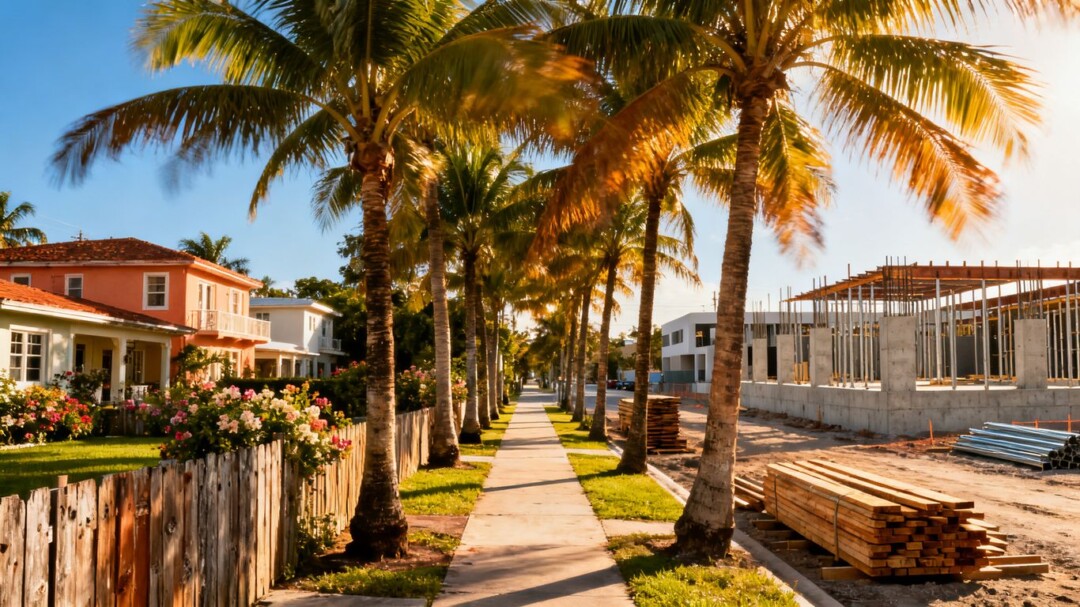
A fast sale of a dated Palmetto Bay home is drawing attention to a changing valuation question: for some properties, is the land worth more than the house? Market figures cited by the David Siddons Group show a wide price gap between resale and newly built homes, while large lots and limited new-home inventory are making certain properties attractive to builders.
Key takeaways
- A 1970 home at 8010 SW 139th Terrace reportedly sold in five days, despite its original finishes.
- The group reports median prices of $511 per square foot for resale homes and $673 for new construction in 2026.
- Large lots may command builder interest, but land estimates depend on location, development potential and costs.
- The figures are market analysis, not a guarantee of what any individual property will sell for.
A quick sale highlights a different kind of buyer
The North Palmetto Bay property at 8010 SW 139th Terrace had not been substantially updated in decades and had only two owners, according to the report. Its five-day sale suggests that some buyers may be looking beyond kitchens and finishes to assess the lot and the potential to renovate or replace the home.
That does not mean every older house is a teardown candidate. The property’s location, lot dimensions, condition and likely resale value after construction all shape what a builder might be willing to pay.
The reported price gap between old and new
For January through September 2026, the report says resale homes—many built in the 1960s and 1970s—closed at a median $511 per square foot, compared with $673 for new construction. It also says new construction accounted for eight of 129 sales, or about 6.2%, and that only three newly built homes were listed as of September.
The group estimates land values at roughly the mid-$50s to low-$70s per lot square foot. Using its example of a 34,000-square-foot lot, that implies an approximate land value of $1.9 million to $2.4 million. These are broad estimates: a property’s usable area, zoning, site conditions and construction economics can change the calculation substantially.
Why a standard comparison may miss the land component
A conventional comparative market analysis often benchmarks a home against nearby resales. A builder may instead estimate the price a completed home could achieve, then subtract construction, financing, demolition and other costs, along with the margin needed to make the project worthwhile. That residual calculation can produce a different valuation—but it does not automatically translate into a higher offer.
The report points to a new home on a 40,511-square-foot lot that sold for $6.2 million in April 2026 as evidence of the market’s upper end. Such a sale helps illustrate demand for finished homes, but it is not a direct valuation comparable for every vacant or older-home lot.
What sellers and buyers should weigh
Owners considering a sale may want to establish whether the likely buyer values the existing home, the land, or both before investing in renovations. For buyers, an original-condition property could offer an opportunity if its purchase price, renovation scope and lot characteristics make sense together.
The central question is not simply whether Palmetto Bay land is rising in value. It is whether a specific parcel can support a profitable project or a worthwhile renovation. Independent valuation and due diligence on local development rules are essential before making a decision.