

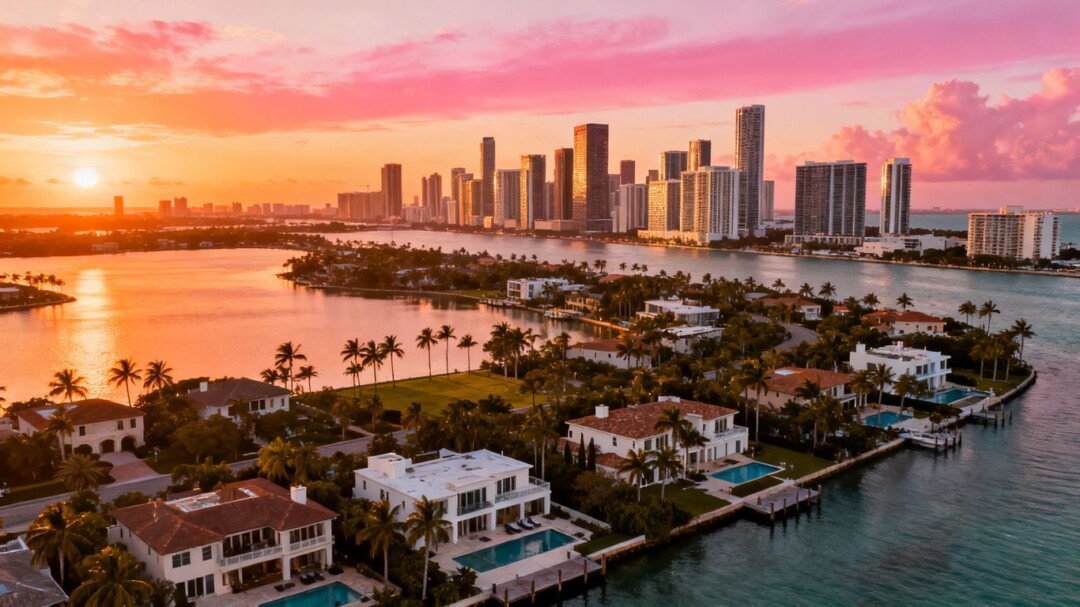
Miami’s real estate market is poised for a dynamic 2026, with a clear divergence between ultra-luxury, scarcity-driven assets and mid-tier condos. David Siddons, a leading luxury broker with over two decades of experience and billions in transactions, offers a data-driven framework for identifying the most promising investment opportunities.
Key Takeaways
- Miami’s market has split: waterfront, ultra-luxury, and scarce assets are performing well, while oversupplied mid-tier condos are facing corrections.
- Single-family homes near top schools offer consistent reliability due to end-user demand and limited supply.
- Waterfront estate homes represent durable wealth preservation with fixed supply and global demand.
- Hospitality-branded oceanfront condos with large floor plans show significant outperformance.
- Pre-construction from proven developers in established areas can offer high returns, but requires careful selection.
- Value-play single-family homes in Coral Gables-adjacent neighborhoods present an accessible entry point.
Single-Family Homes Near Top Schools
Properties in neighborhoods like Coral Gables, Ponce Davis, Coconut Grove, and Pinecrest, particularly those in the $1M-$2M range, are identified as consistently reliable investments. The demand is driven by families relocating to Miami, making these assets end-user focused and less susceptible to market downturns. East Coral Gables, with properties in the $3M-$6M range, is highlighted as a standout performer, absorbing quickly.
Waterfront Estate Homes
For wealth preservation, waterfront estate homes in gated Coral Gables communities (Gables Estates, Old Cutler, Cocoplum) and private island estates (Indian Creek, Star Island, Palm and Hibiscus Islands) are recommended. These properties benefit from permanently fixed supply and global wealth demand, offering a scarcity premium that compounds over time. While not yield-driven, they provide capital preservation with lifestyle value.
Hospitality-Branded Oceanfront Condos
True hospitality-branded residences, such as those partnered with brands like Mandarin Oriental or Four Seasons, have demonstrated significant outperformance compared to regular condos. The key is genuine operational partnerships and service infrastructure. Large-footprint oceanfront residences with features like high ceilings and deep terraces are benchmark examples. Avoid condos licensed with fashion or car brands, which lack substantial operational involvement.
Pre-Construction From Proven Developers
Pre-construction offers a high-return entry point but requires careful selection. Siddons advises buying early in neighborhoods with proven demand drivers from developers with a solid track record in Miami. Buyers should rely on independent market data rather than developer marketing and avoid projects in underdeveloped areas or those with excessive amenities that lead to escalating HOA fees.
Value-Play Single-Family Homes
For investors seeking an accessible entry point, neighborhoods adjacent to Coral Gables offer similar quality at a discount. Areas like Schenley Park, Biltmore Heights, and Glenvar Heights provide a documented quality at a lower price point, with appreciation potential as demand spills over from prime neighborhoods. This strategy is ideal for those with a 5-to-10-year investment horizon.
What to Avoid
Siddons strongly advises against hotel condos, buildings with high investor-renter ratios, new construction from unproven developers, condos in ‘up and coming’ areas without infrastructure, pre-1980 condos with structural issues, cosmetically flipped homes hiding problems, properties in flood hazard zones, homes on busy streets, and any property where the seller or developer is the sole source of market data.