

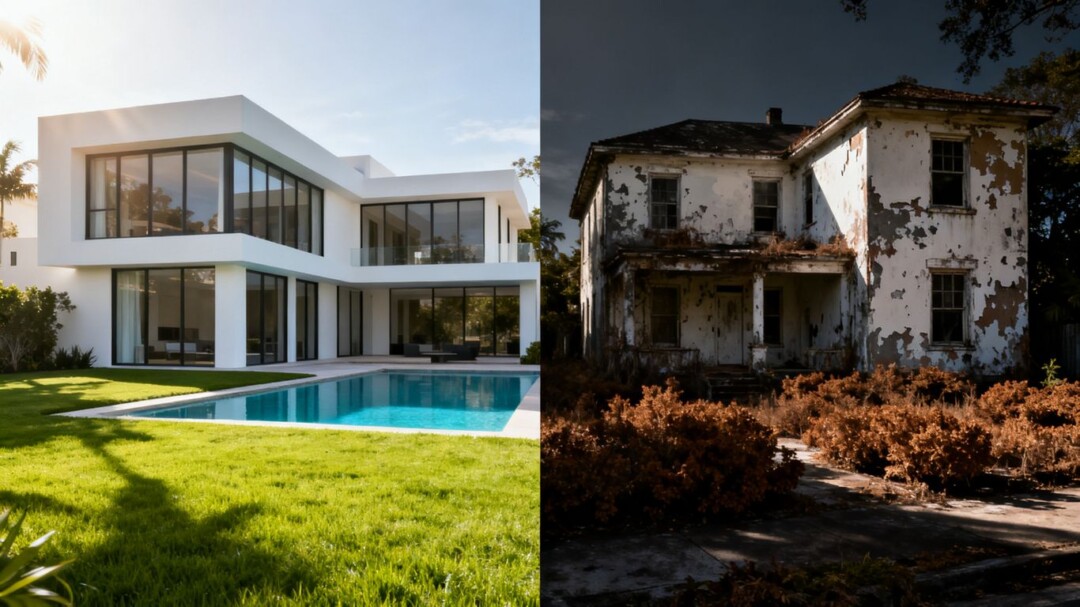
Pinecrest’s luxury housing market is showing a sharp divide. New construction is reportedly reaching about $1,500 per square foot, while many older homes remain closer to $1,000. At the same time, 69 listings expired without selling over the past six months, underscoring how pricing, location, condition and marketing can outweigh broader market momentum.
Key takeaways
- New construction and older homes are competing in different pricing tiers.
- North Pinecrest and areas east of Ludlam Road command notable premiums.
- Aging roofs, HVAC systems and plumbing can reduce a home’s appeal even after cosmetic renovations.
- Luxury buyers expect sophisticated finishes, privacy features and professional marketing.
New construction is setting a difficult benchmark
The headline price of approximately $1,500 per square foot largely reflects newer homes with current designs, updated systems and high-end materials. By contrast, homes built before 2020 reportedly average closer to $1,000 per square foot and generally top out around $1,200.
That gap has created a pricing trap for sellers. Using a nearby new-construction sale as a direct comparison can make an older property appear dramatically overpriced, particularly when its mechanical systems and finishes have not been comprehensively updated.
Pinecrest is not one uniform market
Street-level location also plays a major role. North Pinecrest carries a premium over South Pinecrest, where properties may trade 20% to 25% lower. Homes east of Ludlam Road are also described as commanding more than properties on larger lots farther west.
The result is a layered market in which the street establishes the potential price range, while a home’s age, architecture and finish level determine how close it can come to that ceiling. Comparing properties from different sections of Pinecrest can therefore produce misleading valuations.
Buyers are looking beyond cosmetic upgrades
Homes built between 2005 and 2020 may look modern but still contain aging roofs, air-conditioning equipment and plumbing. Because those systems can approach replacement age together, buyers may discount a property even when its kitchen and bathrooms have been renovated.
Older homes from the 1960s and 1970s that have not undergone major renovations increasingly compete primarily on land value. For sellers, a complete assessment of the structure and systems may be more important than another round of cosmetic improvements.
What supports the top tier of pricing
Properties selling near $1,400 to $1,500 or more per square foot tend to share several characteristics:
- Landscaped perimeter walls or privacy fencing.
- Pitched roofs with substantial wood overhangs.
- Oversized windows and doors with contemporary dark finishes.
- Large-format natural-stone flooring.
- Recessed or trimless lighting and high-quality fixtures.
- Enclosed garage space and covered outdoor living areas.
- Premium appliance packages and stronger overall construction quality.
These features do not guarantee a sale, but their absence can make a high asking price difficult to justify.
Marketing can determine whether a listing gets seen
The analysis also points to exposure as a key reason listings expire. Placement on the multiple listing service is necessary, but luxury properties often depend on targeted digital campaigns, video, social media and outreach to relocating buyers who may not know Pinecrest’s streets or pricing patterns.
For sellers, the central lesson is that a rising neighborhood market does not automatically lift every property. Accurate pricing, property-specific preparation and marketing aimed at the right audience may be the difference between a successful sale and another expired listing.