

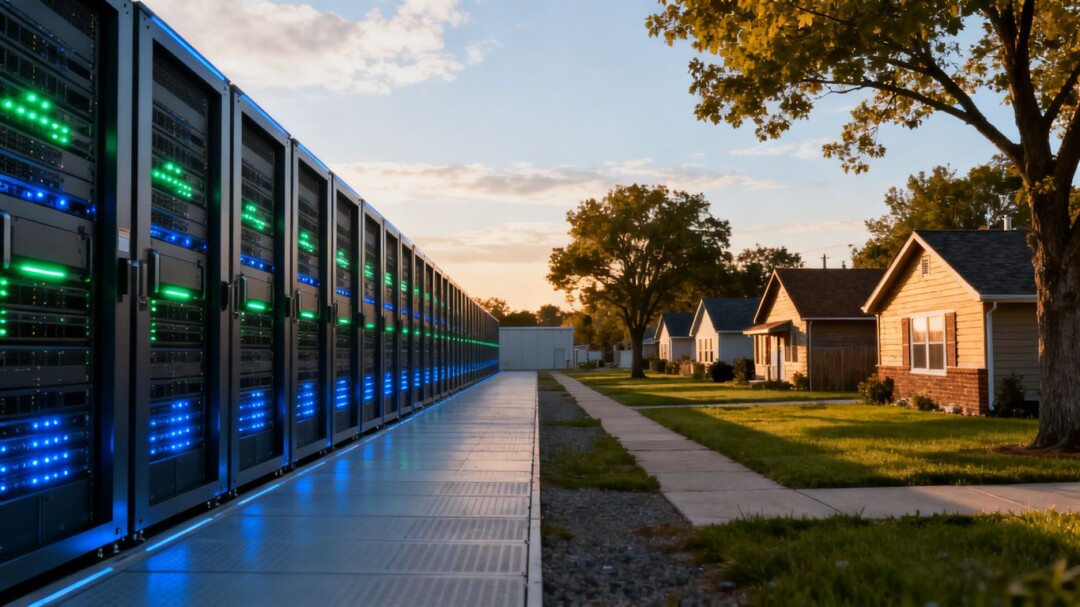
Central Florida’s rapid push to attract large artificial-intelligence data centers is raising questions beyond electricity and water use. Residents appearing at local government meetings are also asking whether the facilities could affect nearby home prices. Real estate professionals say the answer remains uncertain and will depend heavily on location, scale and local decisions.
Key takeaways
- Evidence so far does not show a consistent drop in home prices near data centers.
- Properties immediately adjacent to large facilities could face greater risks.
- Tax revenue and public investment could offset or outweigh potential drawbacks.
- Volusia and Lake counties are considering temporary or permanent limits on development.
What experts are watching
Real estate broker Tom McNamara said it is too early to determine the long-term effect of data centers on residential property values. One study he reviewed indicated that homes directly next to such facilities could experience a negative impact.
However, McNamara said the economic benefits generated by a facility—and how a municipality spends that revenue—could produce positive effects for the surrounding community. He said carefully placing data centers in industrial areas may limit their effect on nearby neighborhoods, provided sufficient power and water are available.
Early housing data offers a mixed picture
A Realtor.com analysis of 43 ZIP codes across the United States found that home prices generally followed similar trends in areas with data centers and areas without them. The findings do not establish that data centers have no effect, however.
The analysis noted that newer facilities are becoming substantially larger. As a result, future developments could create more noticeable effects than earlier projects. Researchers also cautioned that the available observation period is relatively short, leaving open the possibility of longer-term changes in housing demand and values.
Other market forces may matter more—for now
Chris Atwell, president of the Orlando Regional REALTOR Association, said recent year-to-year changes in local property values are more likely connected to broader real estate conditions than to data centers alone.
Mortgage rates, inventory, population growth and neighborhood development can all influence prices. Those factors make it difficult to isolate the effect of a single industrial project, particularly while many proposed facilities are still in planning or construction.
Local governments face competing pressures
Data center developers promote construction employment, tax revenue and other economic benefits. At the same time, residents have raised concerns about power demand, water consumption, noise, traffic and the proximity of large industrial buildings to homes.
Some Central Florida jurisdictions are responding cautiously. Volusia and Lake counties are considering moratoriums or bans, reflecting a debate over whether existing zoning rules adequately address the scale of modern facilities.
Atwell said decisions will ultimately require cooperation among local governments, real estate professionals and residents. For homeowners and prospective buyers, the location of each project, its size, infrastructure demands and the way tax revenue is used may be more important than the simple presence of a data center.
Sources
- Central Florida real estate experts weigh in on data centers, Spectrum News 13.