

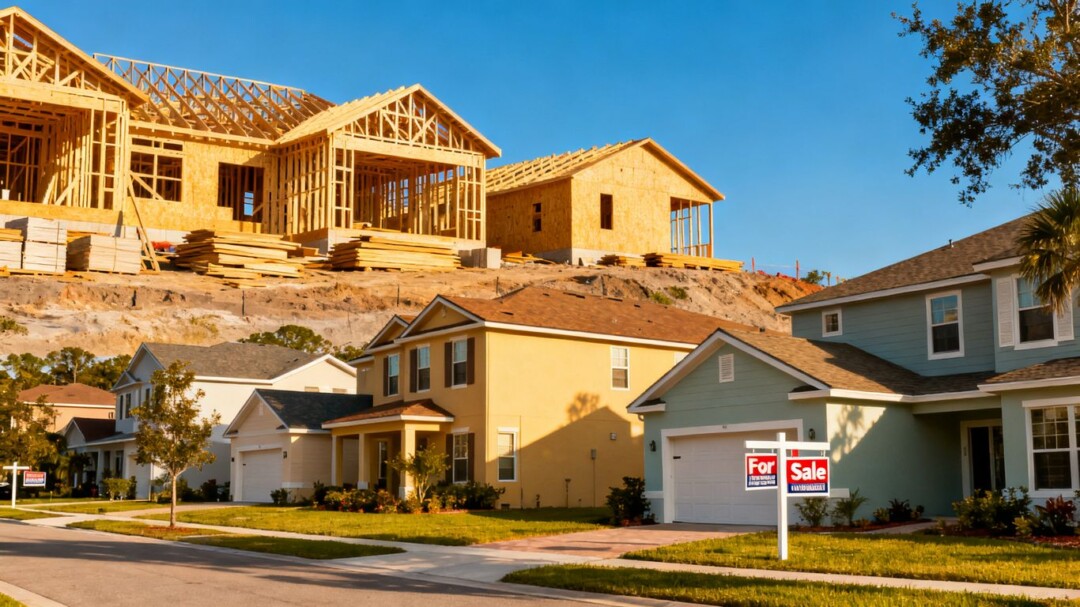
Florida’s housing market is showing mixed but important signs of change in 2026. Affordable listings increased across Miami, Tampa, Orlando and Jacksonville, while housing shortages narrowed in Miami and Jacksonville. At the same time, statewide construction slowed, although Northwest Florida and several counties recorded notable permit growth.
Key takeaways
The latest housing data points to a market that is cooling unevenly rather than entering a broad decline.
- Affordable listings increased in all four major metros studied.
- Miami and Jacksonville reduced their housing deficits.
- Florida recorded 51,444 new-home permits through the second quarter, down 7% year over year.
- Northwest Florida led regional growth, while Central Florida posted the steepest decline.
- Higher-value home construction remained comparatively strong.
Affordability improves across major metros
A Zillow analysis found that the share of listings considered affordable rose between May 2025 and May 2026 in Miami, Tampa, Orlando and Jacksonville. Zillow defines an affordable listing as one for which a household earning the metro’s median income would spend no more than 30% of its income on the monthly mortgage, assuming a 20% down payment.
Jacksonville had the strongest affordability position, with 33.3% of listings qualifying, up from 29.3%. Tampa followed at 32.3%, compared with 27.1% a year earlier. Orlando’s share rose from 23.1% to 27.6%, while Miami increased from 24.1% to 28%.
Housing shortages move in different directions
Supply conditions varied considerably among the four markets. Miami’s estimated housing deficit narrowed by 3,642 units to 68,324, and Jacksonville’s fell by 2,915 units to 10,328.
Orlando and Tampa moved the other way. Orlando’s deficit expanded by 6,000 units to 30,402, while Tampa’s increased by 678 units to 33,878. The differences underscore how statewide and regional housing trends can diverge.
Nationally, the housing deficit remained near 4.7 million units in 2024, increasing by roughly 43,000 homes. New construction added about 1.4 million housing units, helped by the strongest multifamily completion total in five decades.
Construction slows but remains active
Florida issued 51,444 new residential construction permits through the second quarter of 2026, according to HBW Building Activity Trend Report data. The total was 7% below the same period in 2025, following a 4% annual decline in 2025.
HBW characterized the result as a continuation of market easing rather than structural distress. Midyear figures can shift later in the year, making the current numbers a signal of moderation rather than a definitive downturn.
West Florida remained the busiest region with 12,489 permits despite a 14% decline. Southwest Florida followed with 10,988 permits, down 7%, while Central Florida recorded 7,039 permits, a 17% decrease—the largest regional drop.
Growth pockets emerge across the state
Northwest Florida was the strongest-performing region, issuing 7,093 permits, an 11% increase. Southeast Florida also grew modestly, with 5,069 permits, up 1%. Northeast Florida declined 4% to 8,766 permits.
County-level results were even more varied. Manatee County recorded 3,179 permits, up 39%, while Walton County rose 41% to 855. Palm Beach, Lake and Bay counties also posted gains. Lee County led the state in volume with 3,333 permits, but activity there dropped 30%.
Construction of higher-priced homes remained resilient. West Florida led with 1,762 permits for homes valued at $500,000 or more, followed by Southwest Florida with 1,381 and Southeast Florida with 1,344. The pattern suggests demand for premium homes is holding up even as overall building activity moderates.
- Florida housing supply makes gains in parts of Florida, | Florida Realtors.
- Florida home construction cools, but growth pockets emerge, | Florida Realtors.