

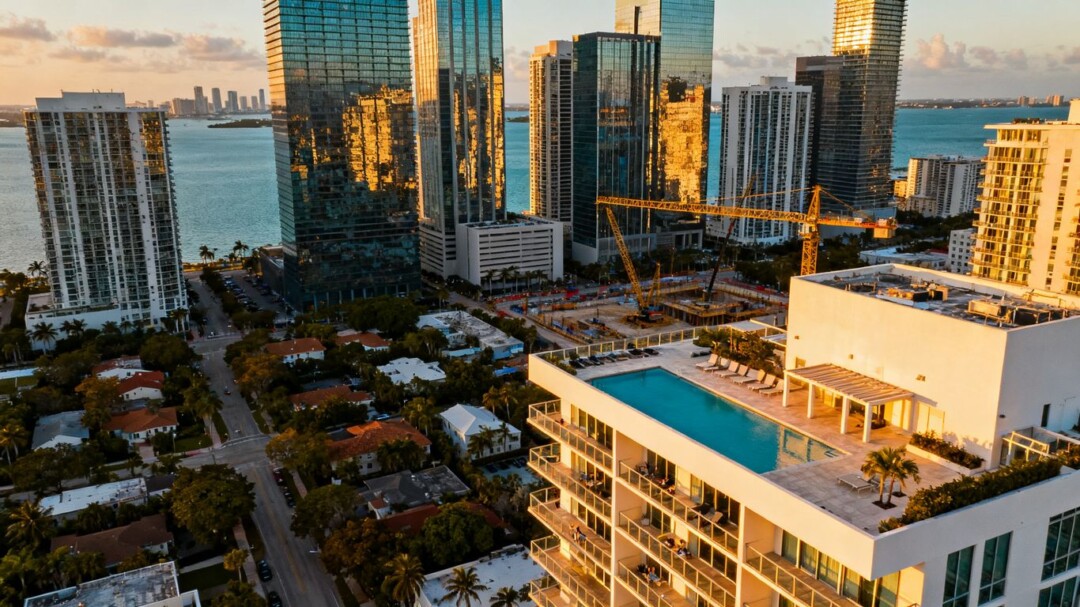
Miami’s expanding office market is offering a new clue to where luxury housing demand may head next. A market analysis argues that long-term leases signed by finance, technology and investment firms could bring executives and high-earning employees to nearby Coral Gables and Coconut Grove, particularly for homes priced from $4 million to $10 million.
Key takeaways
The office boom may support housing demand, but it is not a guarantee of rising prices. The strongest indicators are costly, long-term leases and a limited supply of new homes in some nearby neighborhoods.
- Brickell asking rents reportedly averaged $79.70 per square foot in July 2026, compared with $72 in Manhattan.
- Miami-Dade office leasing reached 1.3 million square feet in the second quarter of 2026, up nearly 45% year over year.
- The analysis identifies Coral Gables and Coconut Grove as likely destinations for employees seeking larger homes, schools and shorter commutes.
- In Coral Gables, it reports that only 10 of 111 homes for sale were new construction, despite strong buyer preference for new homes.
Office commitments point to a different kind of migration
Unlike a household purchase, a corporate lease can represent a decade or more of commitment. The analysis cites an 18,200-square-foot lease by Thiel Capital at 830 Brickell at a reported $250 per square foot, as well as expansion by Google at 1450 Brickell. It also points to Citadel’s planned headquarters tower as evidence of continued corporate investment.
Such commitments can signal that companies expect to maintain a substantial Miami presence. Still, office rents alone cannot establish how many employees will relocate, what salaries they will earn or whether they will buy homes locally. The analysis’s estimates of payroll and likely housing budgets are projections, not confirmed household purchases.
Nearby neighborhoods offer distinct trade-offs
Coral Gables and Coconut Grove appeal to buyers seeking single-family homes within reach of Brickell, while offering a different setting from the dense office district. The report places typical rush-hour drives at roughly 20 to 30 minutes from Coral Gables and 15 to 20 minutes from the Grove, though actual travel times vary.
Coconut Grove also has a growing commercial profile of its own. The analysis notes that some new office space there is being marketed at premium rents, potentially allowing more employees to live close to work. For both neighborhoods, access to schools, space and waterfront amenities may factor into decisions alongside commute time.
Limited new-home supply may shape competition
The report says three-quarters of Coral Gables buyers prefer new homes, while new construction makes up about 9% of the 111 homes it counted for sale. That imbalance could push some buyers toward existing properties or intensify competition for new listings. These figures are a market snapshot, not a measure of every price range or future inventory.
A promising signal, not a housing forecast
The office expansion strengthens the case that Miami’s corporate growth could support luxury housing demand beyond Brickell. But hiring trends, financing costs, construction and the availability of homes will also matter. The lease market is a useful indicator of business confidence; it cannot, by itself, predict prices or sales in Coral Gables and Coconut Grove.