

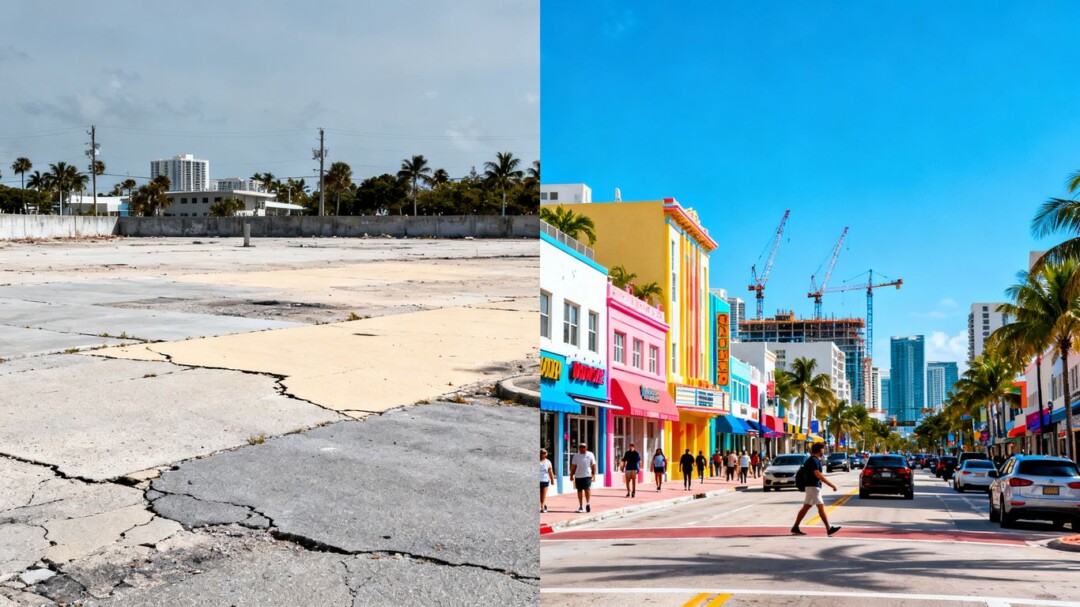
Miami’s housing market is struggling to keep pace with the city’s growth, according to Realtor.com’s 2026 Metro Report Cards. The metro earned a failing grade for a combination of poor affordability and relatively weak homebuilding. Across Florida, several other markets scored substantially better, aided by room to expand and lower-cost land.
Key takeaways
- Miami scored 29 out of 100, earning an F; affordability was its weakest measure.
- The median-priced home costs $507,237, while the typical new build carries a steep premium over an existing home.
- Jacksonville and Palm Bay each scored above 70, with stronger homebuilding performance.
- Experts say denser construction, faster approvals and preserving attainable homes could help Miami.
A failing grade despite visible construction
Miami received an overall score of 29, including 18.9 for affordability and 39.1 for homebuilding. It was one of 13 major U.S. metros to earn an F—and the only failing metro in Florida, a state that received a B in Realtor.com’s separate state report cards.
The report illustrates a gap between construction activity and housing that local households can afford. Miami had the largest new-construction premium among the 100 largest U.S. metros: a newly built home costs 248% more than the median-priced resale home, according to the analysis.
Geography and costs limit supply
The Atlantic Ocean and Everglades restrict Miami’s ability to expand outward, leaving developers with less available land than in many Florida markets. Expensive land, construction labor, financing and insurance, along with lengthy or uncertain approvals, further raise the cost of projects.
Those economics can steer builders toward higher-priced condominiums rather than homes affordable to typical buyers. Miami’s median household income is $74,274, while the median-priced home is $507,237. A median earner would spend nearly 47% of annual income on the monthly payment for that home, well above the commonly cited 30% affordability threshold.
Florida markets diverge
Jacksonville and Palm Bay each scored above 70 overall, receiving A- grades and ranking among the nation’s top 10 metros in the report. Lakeland, Cape Coral, North Port and Orlando also earned grades in the B range.
The report’s experts point to suburban growth on less expensive land as one advantage for these markets. Miami, meanwhile, faces added pressures associated with coastal property insurance and heightened scrutiny of condominium reserves following the 2021 Surfside building collapse.
Possible paths toward more attainable housing
Experts cited denser development near transit and jobs, redevelopment of underused properties and faster, more predictable permitting as potential ways to reduce barriers and costs. Florida’s Live Local Act, which allows taller and denser housing in certain commercial areas, is another approach highlighted in the report.
No single change is likely to resolve Miami’s affordability problem quickly. The central challenge is ensuring that new supply includes homes within reach of local incomes, while making more efficient use of limited land and preserving existing attainable housing.