

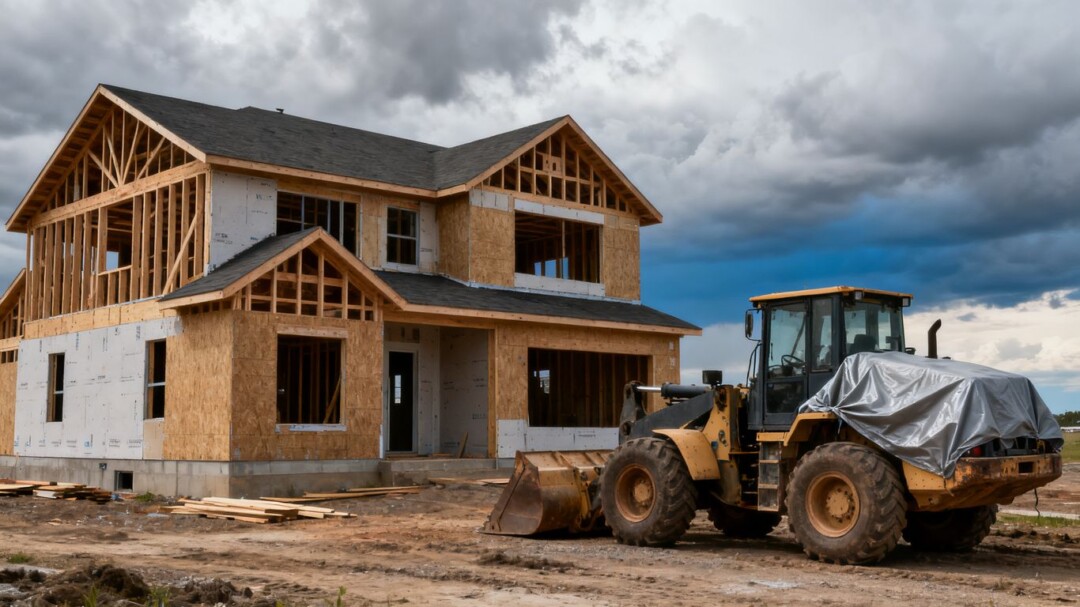
Higher mortgage rates and rising new-home prices are putting renewed pressure on housing affordability, while demand for newly built homes and construction activity weakened in July. Recent data from the National Association of Home Builders, Mortgage Bankers Association and Census Bureau point to a market caught between persistent housing shortages and buyers’ growing sensitivity to monthly costs.
Key takeaways
- The mortgage burden for a median-income family buying a new home rose to 34% in the second quarter.
- Applications for new-home purchase mortgages fell 5.7% year over year in July.
- Housing starts dropped 12.4% from June, while completions fell 9.1%.
- Building permits increased, suggesting future construction could recover if demand improves.
These figures show that affordability challenges are affecting both sides of the housing market. Buyers are facing higher financing costs, while builders are contending with elevated expenses, labor shortages and uncertainty about future demand.
Affordability worsens as rates and prices rise
The NAHB’s Cost of Housing Index found that a family earning the national median income of $106,800 needed to devote 34% of its income to the mortgage payment on a median-priced new home during the second quarter. That compared with 32% in the first quarter.
The typical 30-year mortgage rate rose from 6.20% to 6.51% during the period, while the median new-home price increased 2%, from $403,200 to $410,700. Lower-income households faced an even heavier burden: Families earning half the national median income needed to allocate 67% of their income to the mortgage, up from 65%.
Affordability also deteriorated for existing homes. The mortgage share for a typical family increased from 32% to 36% of income, underscoring the broader impact of borrowing costs.
New-home demand loses momentum
Mortgage applications for new-home purchases declined 1% from June and 5.7% from a year earlier, according to the MBA. The estimated annualized pace of new single-family home sales fell to 647,000 in July, down from 667,000 in June and below the 664,000 average recorded during the first half of the year.
It was the third monthly decline in the annualized sales pace in four months. The average loan size also edged down to $374,438, indicating that some buyers may be adjusting their budgets as financing becomes more expensive.
Construction activity drops despite more permits
Census Bureau data showed housing starts falling to a seasonally adjusted annual rate of 1.239 million in July. That was 12.4% below June and 13.5% below July 2025. Single-family starts declined 9.9% from the prior month to 808,000.
Completions also weakened, reaching an annualized rate of 1.212 million—down 9.1% from June and 16.8% from a year earlier. Single-family completions fell 5.8% to 878,000.
Building permits offered a more positive signal. Permits reached an annualized rate of 1.443 million, up 5% from June and 3.1% from a year earlier. Single-family authorizations rose 2.5% to 894,000, suggesting builders remain positioned to increase activity if sales conditions become more favorable.
Housing shortage remains a long-term concern
The slowdown comes as the nation continues to face an estimated shortage of about 1.2 million housing units. Industry officials say reducing regulatory barriers, construction costs and labor constraints will be important to expanding supply.
For now, however, higher rates are causing households to reassess what they can afford. That tension is likely to keep new-home sales and construction uneven until financing conditions improve or home prices become more accessible.