

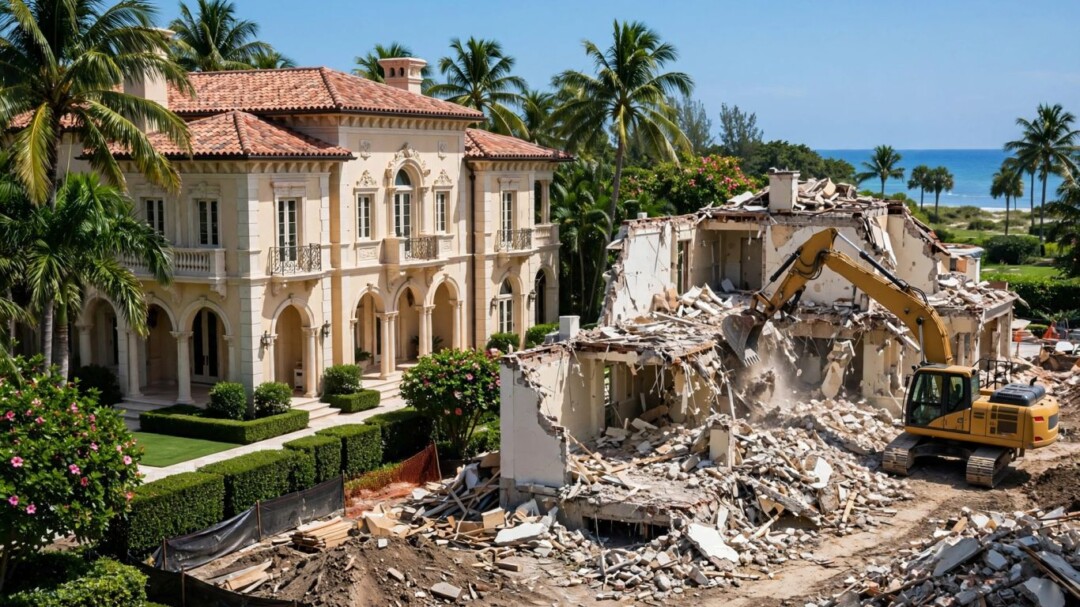
Some of America’s most expensive homes are being treated not as finished masterpieces but as prime land for a buyer’s own vision. A report on the trend points to Palm Beach, where cosmetics heir William Lauder bought Rush Limbaugh’s estate for $155 million in 2023—and had the mansion demolished months later.
Key takeaways
- Ultrawealthy buyers may purchase lavish estates for the property, not the existing house.
- William Lauder’s $155 million acquisition of Limbaugh’s Palm Beach mansion is a prominent example.
- The demolition illustrates how a costly, high-profile home can become a blank slate for redevelopment.
A record-setting purchase, followed by demolition
Lauder, an heir to the Estée Lauder fortune, bought the Palm Beach megamansion once owned by conservative radio host Rush Limbaugh in March 2023. The reported $155 million sale set a record at the time. A few months after the purchase, Lauder had the mansion torn down.
The sequence underscores the unusual economics of the ultra-luxury market: a buyer can pay a landmark price for a residence and still decide that the structure itself does not fit their plans. In such cases, the land and location may be more valuable to the new owner than the home’s architecture or amenities.
A costly home as a blank canvas
The reported Palm Beach case reflects a broader pattern among wealthy buyers, who are acquiring opulent estates from Florida to California and replacing them with properties tailored to personal preferences. The homes may be impressive, but they can be viewed as an expensive starting point rather than a finished product.
Demolition also highlights the contrast between the public perception of a $100 million-plus mansion as a trophy residence and a buyer’s private calculation about what to keep. For owners with the resources to rebuild, even a recently purchased estate can be treated as a site for a new custom vision.
What the example reveals—and what it doesn’t
Lauder’s purchase and demolition provide a striking illustration, but the reported account offers no figures on how common such teardowns are, how much reconstruction costs, or what ultimately will replace the Palm Beach mansion. It therefore points to a visible luxury-market practice rather than quantifying its scale.
Still, the example makes clear that in the highest tier of real estate, an extraordinary sale price does not guarantee a home will be preserved. For some buyers, the ultimate status property is not the mansion they acquire, but the one they choose to build in its place.