

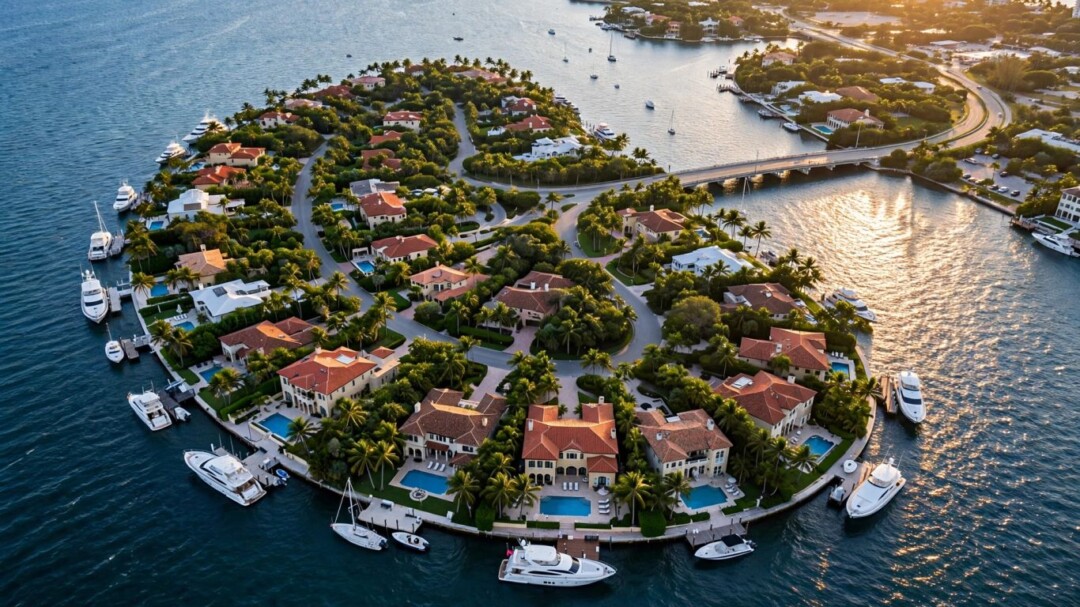
A recent buyer’s guide to Miami Beach’s Sunset Islands spotlights a rare combination: guard-controlled access, single-family homes and usable Biscayne Bay waterfront close to the city’s restaurants and business districts. The four-island enclave has about 250 homes, and the guide’s 2026 figures show a steep price divide between interior lots and waterfront properties.
Key takeaways
- Sunset Islands comprises four guarded islands with roughly 250 single-family homes and no public through-roads.
- The guide reports 2026 prices of $4 million to $16.5 million for dry-lot homes and $26 million to $35 million for waterfront homes.
- Buyers are advised to check dock suitability, seawall condition, flood exposure and island-specific association rules.
- Limited inventory and private sales can make market research more challenging than simply tracking public listings.
A low-density enclave near the city
The islands sit in Biscayne Bay and are accessed from North Bay Road through guarded entrances serving Islands I and II and Islands III and IV. Streets end at the water, and the neighborhood is made up of single-family homes rather than condo towers or hotels. The guide describes Sunset Harbour as within walking distance of one entrance, with Lincoln Road, the beach and central Miami destinations a short drive away.
That location helps distinguish the community from more isolated private islands. Residents can have controlled access and a residential setting while remaining close to restaurants, marinas and services. A residents’ park on Island II and two homeowner associations also contribute to the area’s community structure.
Waterfront features shape the market
According to the guide, 2026 sales for dry-lot homes ranged from $4 million to $16.5 million, while waterfront homes ranged from $26 million to $35 million. It puts average prices at about $2,200 per square foot for dry-lot homes and $4,900 for waterfront properties. These are figures reported by the guide, not a guarantee of current asking or sale prices.
Waterfront properties may include private docks and access to Biscayne Bay, the Intracoastal Waterway and the Atlantic. But the guide emphasizes that dock conditions differ by lot. Buyers should verify water depth, route clearance for their vessel, dock permits and seawall condition before making an offer. Bayfront exposure can bring broad views and sunsets, while canal settings may offer calmer docking conditions.
Ownership costs and due diligence
The guide flags flood and storm exposure as central considerations. The low-lying islands face risks from storm surge and high tides, and owners may need flood and windstorm insurance. Seawall maintenance is generally a private-owner responsibility; salt air can also accelerate wear on docks, roofs and fixtures.
Other costs may include property taxes and association dues. The guide estimates association fees of roughly $250 to $420 a month, while some properties on Islands III and IV may also face a one-time initiation charge at closing. Buyers should confirm current fees, rules and any applicable charges directly with the relevant association.
Scarcity and private transactions
With a limited number of homes, listings may be infrequent, and the guide says some transactions take place privately rather than on public listing platforms. It also notes that some buyers focus on a property’s land, frontage and dock potential, then consider rebuilding. Before pursuing that strategy, buyers should confirm zoning, design-review requirements, elevation standards, permitting and construction costs with qualified local professionals.