

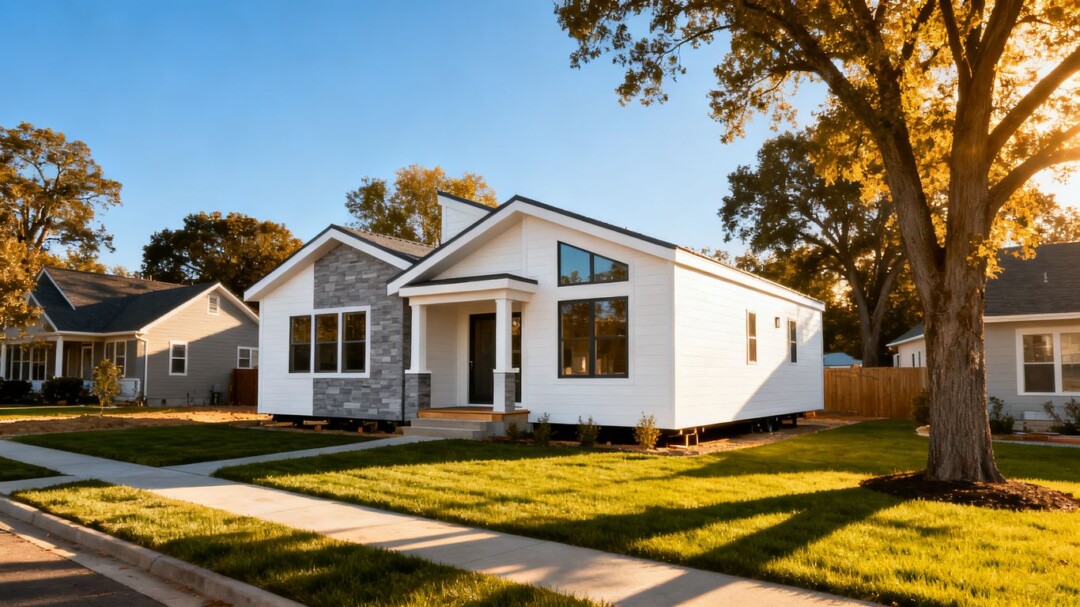
Florida’s 2026 zoning law changes how local governments must treat qualifying homes built partly or entirely off-site. Where detached single-family homes are allowed, these dwellings generally must be permitted on the same terms as site-built houses. The measure limits construction-method-based barriers while leaving local governments authority over generally applicable site and design standards.
Key takeaways
- Qualifying off-site constructed homes must be allowed as of right in districts that permit detached single-family homes.
- Local rules may not treat them more restrictively solely because of how or where they were built.
- Equal standards for design, setbacks and other site characteristics still apply.
- Building-code, installation and private-covenant requirements remain in place.
The change establishes zoning parity, not automatic approval for every project. Its practical effect will depend on whether more builders can use ordinary single-family lots for factory-built housing.
What the law changes
Florida Statutes section 553.385 covers qualifying off-site constructed residential dwellings, including certain factory-built and manufactured homes intended for single-family use and treated as real property. The law requires local governments to permit these homes in any zoning district where detached single-family dwellings are allowed.
Counties and municipalities may not exclude qualifying homes or impose more restrictive zoning, land-use or development rules because of the home’s construction method or location. Conflicting local provisions are unenforceable as applied to covered dwellings.
Local standards still apply
The measure does not remove local authority over a home’s site or characteristics. Governments may continue to apply standards such as setbacks, height, lot dimensions, roof pitch, exterior materials and orientation, provided comparable site-built homes face the same requirements.
Projects must also meet applicable building-code, floodplain, drainage, infrastructure and installation rules. Florida’s state approval framework for covered manufactured buildings remains in effect, and the zoning statute does not on its face override private deed restrictions or homeowners’ association covenants.
Unanimous support, uncertain impact
HB 803, which included the zoning-parity provision and took effect July 1, 2026, passed the Florida House 114-0 and the Senate 37-0. The House later approved the amended bill 109-0. The provision was also enacted through overlapping legislation.
For builders, the law could make more lots viable for modular and other off-site construction by reducing the need to navigate a separate zoning category in each locality. But parity does not guarantee lower costs or broader adoption: land prices, financing, insurance, infrastructure and consumer perceptions will continue to shape whether projects move forward.
A new baseline for development review
The law shifts the starting point for local decisions. Rather than requiring factory-built homes to win special permission, local governments generally must treat qualifying dwellings like site-built single-family homes in the same district. Whether that legal change results in more homes on ordinary residential lots will be the clearest test of its effect.
- Florida Law Requires Zoning Parity for Off-site Homes, HousingWire.