

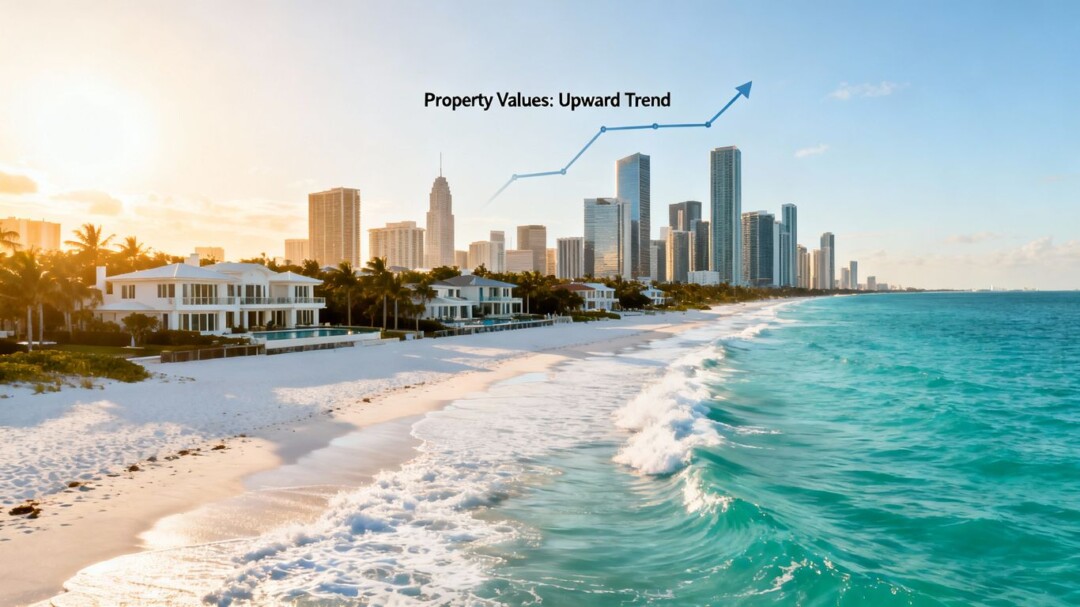
As 2025 approaches, the Miami luxury real estate market is poised for potential shifts driven by anticipated drops in mortgage rates. Even a modest decrease could significantly impact buyer purchasing power, inventory absorption, and overall market urgency. Both prospective buyers and sellers are advised to understand these dynamics to navigate the market effectively.
Key Takeaways
- A 0.5% drop in mortgage rates can increase purchasing power by 5-6%.
- Such a rate decrease can boost buyer demand by 8-12% in subsequent months.
- The impact of falling rates is felt across various price points, with psychological effects at the higher end.
- Strategic decisions about buying now versus waiting depend heavily on specific Miami submarkets.
The Impact of Lower Mortgage Rates on Purchasing Power
A decrease of just 0.5% in mortgage rates can translate to a substantial increase in what buyers can afford. For instance, a buyer who could afford a $2 million home at a 6.5% interest rate might be able to stretch to $2.1 million with the same monthly payment if rates fall to 6.0%. Historically, in Miami, a 0.5% rate drop in 2020-2021 led to a 12-15% surge in condo sales, particularly in the $500,000 to $2 million range where financing is most critical.
Supercharging Demand in Miami’s Real Estate Market
Data from the National Association of Realtors and Mortgage Bankers Association suggests that a 0.5% reduction in mortgage rates can stimulate buyer demand by 8-12% within months, especially in markets with limited inventory. This aligns with Miami’s Multiple Listing Service data, which has shown a visible increase in pending sales following small rate drops in late 2019 and early 2023. This heightened demand can lead to quicker absorption of available properties.
Will Falling Rates Drive Up Miami Home Prices?
When demand increases, especially in desirable areas with low inventory, available properties are absorbed more rapidly. This can lead to quicker price appreciation. While markets with higher inventory might see a softer effect, increased demand generally reduces the room for price negotiations, potentially pushing prices upward.
Which Miami Price Points Benefit Most?
While the $1 million to $3 million segment experiences the most direct benefit due to higher financing dependence, the effects ripple further. In the ultra-luxury market ($5 million+), where many buyers use cash, lower rates have a more psychological impact. They signal market stability, expand the future pool of financed buyers, and boost confidence in liquidity and resale values. This often accelerates decision-making for high-net-worth individuals, creating urgency even if affordability isn’t the primary driver.
Strategic Decisions: Buy Now or Wait?
The decision to buy now or wait for lower rates in Miami depends on the specific neighborhood. In supply-constrained areas like Coconut Grove and Coral Gables (targeting $2 million-$5 million properties), waiting might prove more costly due to steady demand from relocating families. For ultra-luxury properties ($5 million+) in exclusive enclaves like South of Fifth, Continuum, Apogee, and Fisher Island, securing a scarce property often outweighs waiting for a minor rate adjustment. Conversely, areas like Brickell, Edgewater, and Downtown, with a higher concentration of rate-sensitive, investor-driven condos ($800,000-$2 million), might offer more leverage and appreciation potential for buyers who wait for lower rates.
Benefits for Cash Buyers
Even cash buyers stand to gain from falling interest rates. Lower rates expand the pool of financed buyers, which can strengthen resale values and liquidity. Furthermore, rate cuts often boost overall market confidence, potentially driving prices higher. This means cash buyers who act early can capitalize on the market before demand spikes. Additionally, cheaper borrowing options allow cash buyers to redeploy capital into other investments while maintaining a competitive edge in securing properties.